21 April 2026 - UCISA26 Beatriz Lorenzo-Gonzalez Reflections
From Digital Projects to Institutional Capability: Reflections from UCISA26
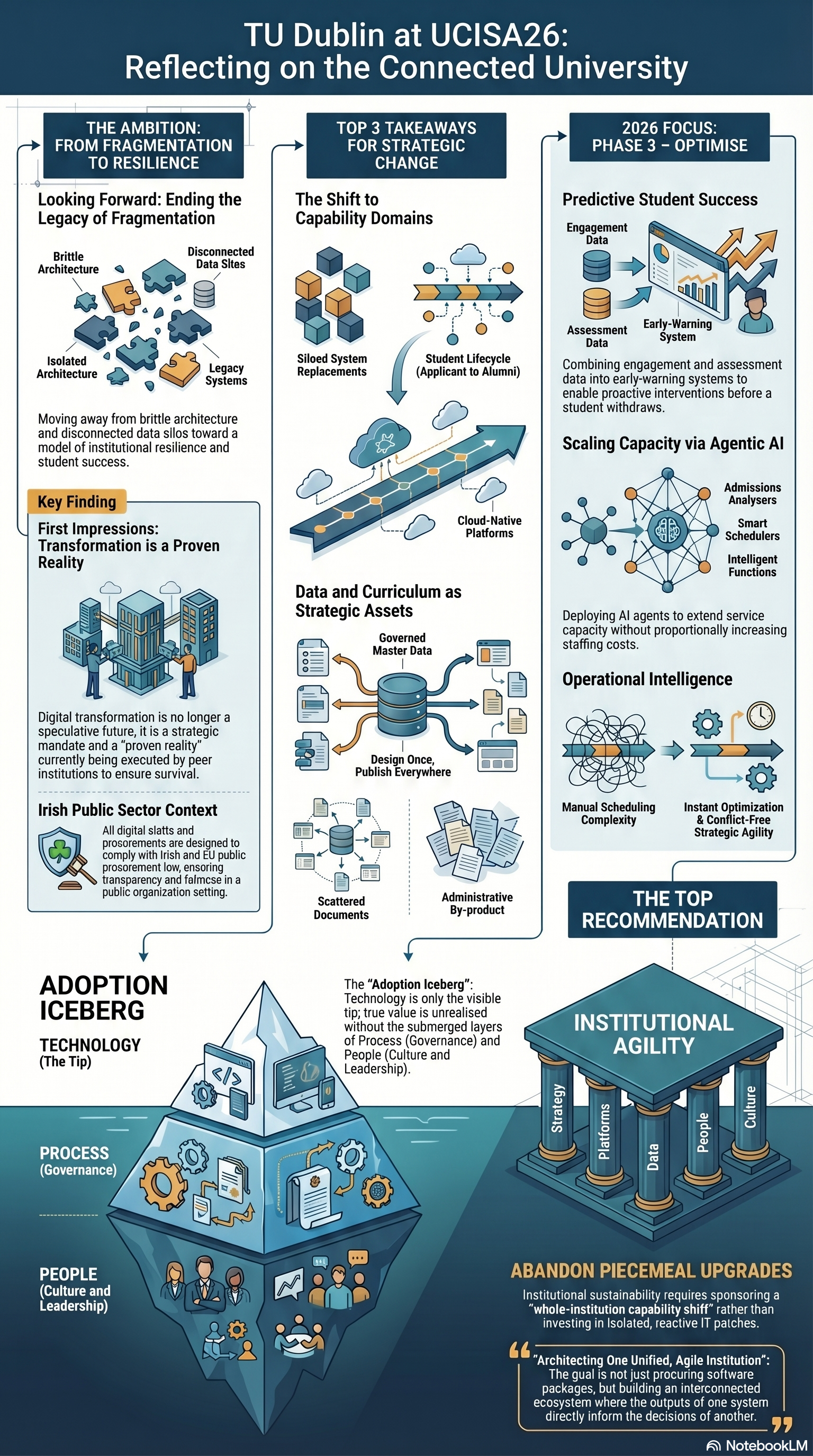
UCISA26 reinforced something we at TU Dublin have been experiencing first‑hand: digital transformation in Higher Education has moved decisively beyond Information Technologies Services and Systems implementation. What is now at stake is institutional capability, the ability to operate coherently, securely and intelligently at scale.Going into the UCISA26 Leadership Summit, I was particularly interested in understanding how peer institutions are responding to a shared set of tensions: fragmented legacy estates, growing financial constraints, escalating cybersecurity risk, and increasingly sophisticated student expectations. I was also keen to explore how data, analytics and emerging AI capabilities are being embedded as part of whole‑institution operating models.
My early impression from UCISA26 Leadership Summit was one of strong sector convergence. While contexts differ, the strategic direction is remarkably consistent. Digital Transformation is no longer framed as discretionary innovation; it is now widely recognised as fundamental to institutional sustainability and performance. Across sessions and conversations, there was a clear shift away from technology‑centric narratives towards conversations about governance, ownership, partnership, resilience and adoption.
Three takeaways stood out most strongly for me.
First, capability matters more than projects.
Institutions that are making progress are those designing joined‑up capability across the full student lifecycle, rather than acquiring disconnected point solutions or standalone systems. This includes treating Curriculum as governed master data, aligning identity and access management with organisational roles, and designing cybersecurity and resilience as architectural foundations rather than after‑the‑fact controls. This capability‑led approach is central to the Connected University Network Programme we have been developing at TU Dublin, and UCISA26 Leadership Summit provided strong validation of that direction.
Second, data and AI are enabling decision advantage — not just reporting.
There was a noticeable maturity in how analytics and AI are being discussed across the High Education sector. The focus is no longer on dashboards for their own sake, but on creating trusted data platforms that support predictive insight, early intervention, and evidence‑based decision-making processes. Used properly, these capabilities help amplify professional judgement.
Third, adoption determines value.
A consistent message from UCISA26 Leadership Summit was that Technology delivers no benefit without sustained change in behaviours, processes and decision‑making practices. Institutions that treat change, engagement and adoption as first‑class workstreams — with clear ownership and leadership sponsorship — are far more likely to realise value. This aligns closely with our own experience at TU DUBLIN: delivery, discipline and cultural adoption are inseparable from successful digital transformation.
For colleagues attending UCISA26 Leadership Summit for the first time, my strongest recommendation would be this: arrive with a blueprint mindset, not a shopping list. Focus on outcomes, integration, scale and ownership. Ask how capabilities fit together, how they will be governed, and how adoption will be sustained. The most valuable outcomes from UCISA26 Leadership Summit are not products taken back to my institution, but insight — insight that helps leaders design institutions that are coherent, resilient and ready for what comes next.
At TU Dublin, UCISA26 Leadership Summit has reinforced confidence in our current direction and provided valuable perspective as we continue evolving from digital ambition to institutional capability.